How it works
Follow a rand through the loop.
Money comes in however your customers already pay, gets used inside your network instead of sitting in someone else's, and only leaves when a person actually needs it outside the network. Here's the whole journey, one rand at a time.
01In
Money in, on every rail
Your customers already know how to pay you. Whatever they use lands in the same balance, so nothing you accept today has to change and nobody has to be taught a new way to pay.
- Bank
- Card
- Cash
- QR
02Working
Money working, not waiting
Send, request, split a bill, run a payout. Inside your network it settles on the spot with no transfer fee. The float between what you collected and what you owe is yours, and settlement always comes first.
- Send
- Request
- Split
- Pay out
03Out
Money out, only when it must
When someone needs money outside the network, it goes: to a bank account, a card, a till or across a border. That's the one step worth paying for.
- Bank
- Card
- Till
- Abroad
Bank covers PayShap, RTC and EFT. Card is a Visa or Mastercard top-up, debit or credit, through Pay@. Cash is Pay@ at the till. QR is Zapper. Abroad is 37 African corridors.
One rand, start to finish
Thandi's R100, and where it goes.
- 01 InBank · instant
R100 comes in.
Thandi tops up by instant bank transfer. The money is in the network the moment her bank confirms, and spendable within seconds.
- Movement
- +R100
- In the wallet
- R100
Spendable within seconds
- 02 WorkingWallet to wallet
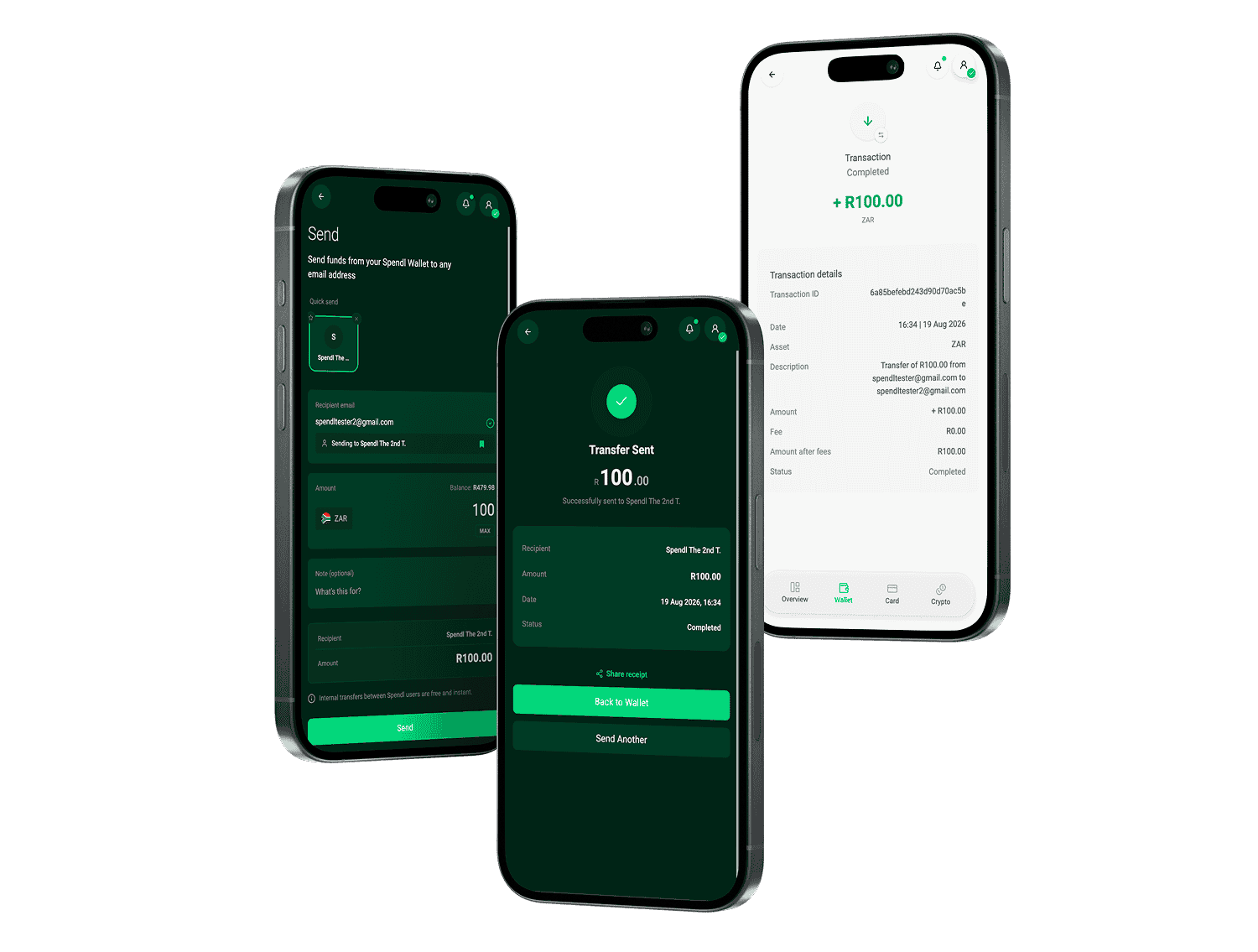
R40 goes to Joe.
Both wallets sit on the same ledger, so there's no clearing house in between, no transfer fee and nothing to wait for.
- Movement
- −R40
- In the wallet
- R60
- Fee
- Transfer fee R0
Settled on the spot
- 02 WorkingPayment request
R40 comes back for the taxi.
Thandi requests R20 from two friends. Each pays in a tap, the request archives itself, and nobody has to chase anyone.
- Movement
- +R40
- In the wallet
- R100
- Fee
- Transfer fee R0
Settled on the spot
- 03 OutBank · EFT
R50 goes to the bank, and the rest stays put.
Thandi sends R50 to her bank account. That leg rides a bank rail, so it carries the rail’s fee, shown before she confirms, and stays pending until the bank says yes. The rest never had to go anywhere.
- Movement
- −R50
- In the wallet
- R50 less fees
Pending until the bank confirms
Amounts are an illustration. In-network transfers carry no transfer fee. The bank leg carries the rail’s fee, and the wallet shows it before she confirms.
The honest split
What settles instantly, and what has to wait.
Anything between two wallets settles immediately. Anything that crosses a bank or a border waits for that partner to confirm, and the wallet shows it as pending until they do.
Settles on the spot
- Wallet to walletTwo wallets on one ledger. No clearing house, no transfer fee.
- Payment requestsPaid in a tap, settled the same instant.
- Bill splitsEveryone pays for their own line items, inside the wallet.
- Batch payouts to existing walletsA hundred recipients settle as fast as one.
- Instant bank depositsPayShap and RTC deposits are spendable within seconds of the bank confirming.
Waits on a partner rail
- EFT depositsReflect once the bank clears them, usually within hours.
- Bank withdrawalsFee shown before confirmation. Pending until the bank rail confirms.
- Cross-borderRate and fee are shown before confirmation. Pending until the corridor partner confirms.
- Money for someone not yet in the networkWaits for them to sign up and claim it. Unclaimed money returns after 90 days.
The economics
Transfers inside the network are free and instant.
The moment money must leave, for a bank, a till or a corridor, it rides a partner rail. That's the one leg with a cost attached, and the wallet shows it before anyone confirms.
Get started
Keep the next rand you move.
See a branded wallet, cross-border and the Public API running on your own numbers. Onboarding is hands-on, whatever the size of your team.
or email support@spendl.money